Does Cold Plunging Burn Calories?
By PLUNJ · July 14, 2026
Yes, cold plunging burns calories. A typical 2-5 minute session in 50-59°F water burns roughly 100-200 calories, driven by your body working to generate heat and maintain core temperature. The exact number depends on water temperature, session length, your body composition, and how acclimated you are to cold exposure.
That said, "burns calories" and "causes weight loss" are two different questions. Here's what's actually happening in your body, how the number is calculated, and how much it really matters.
How Your Body Burns Calories in Cold Water
When you submerge in cold water, your core temperature starts to drop. Your body responds with two heat-generating processes, both of which cost energy:
1. Shivering thermogenesis
This is the obvious one—your muscles contract rapidly and involuntarily to generate heat. It's the same mechanism that burns calories when you're cold on a winter walk, just more intense because water conducts heat away from your body roughly 25 times faster than air.
2. Non-shivering thermogenesis (brown fat activation)
This is the less obvious, more interesting mechanism. Your body has a special type of fat—brown adipose tissue (brown fat)—whose entire job is to burn fuel and generate heat rather than store energy like regular white fat. Cold exposure activates brown fat, which contains a protein called UCP1 that lets mitochondria burn glucose and fatty acids purely to produce warmth.
Regular cold exposure increases both the amount of brown fat you have and how efficiently it activates—meaning consistent cold plungers burn more calories via this pathway over time than someone doing it for the first time.
How Many Calories Does a Cold Plunge Actually Burn?
Research on cold water immersion and metabolic rate puts the numbers roughly at:
- Short session (2-3 min, 50-59°F): ~100-150 calories
- Longer session (5+ min, colder water): ~150-250 calories
- Elevated metabolic rate afterward: Your metabolism can stay slightly elevated for a period after you get out, adding a modest amount on top of the session itself
For context, that's roughly comparable to 15-20 minutes of brisk walking—not nothing, but not a workout replacement either.
Factors That Change the Number
Water temperature: Colder water increases calorie burn, but the relationship isn't linear—extreme cold mostly increases discomfort and risk, not proportional calorie burn. Consistent, tolerable cold (50-59°F) is more sustainable than chasing the coldest possible water.
Session duration: Longer exposure burns more calories up to a point, but diminishing returns (and safety limits) kick in past 5-10 minutes for most people.
Body composition: More muscle mass generates more heat through shivering, so leaner, more muscular individuals often burn slightly more per session.
Acclimation level: This one surprises people—the more used to cold you become, the less you shiver, because your body gets better at non-shivering thermogenesis instead. Acclimated cold plungers may burn fewer calories through visible shivering but are activating more brown fat in the background.
Comparing Cold Plunge Calories to Other Activities
- Cold plunge (2-5 min): ~100-200 calories
- Sauna session (15-20 min): ~100-200 calories (through elevated heart rate and sweating, a different mechanism than cold)
- Brisk 20-minute walk: ~100-120 calories
- 30 minutes of resistance training: ~150-250 calories
Cold plunging is in the same rough range as light-to-moderate exercise, just compressed into a much shorter window.
Does Burning These Calories Mean You'll Lose Weight?
Not by itself. A 100-200 calorie burn is meaningful, but it's a small piece of the weight loss equation compared to your overall diet and activity level. Where cold plunging actually helps weight loss over time isn't just the calories burned in the moment—it's the downstream effects: increased resting metabolic rate from more active brown fat, improved insulin sensitivity, and better appetite regulation.
If weight loss is your goal, read our full breakdown of how cold plunging fits into a weight loss protocol and how it interacts with insulin sensitivity in our insulin sensitivity guide.
The Afterburn Effect
One reason cold plunging punches above its weight: the calorie burn doesn't stop the moment you get out. Your body continues working to restore core temperature and, if brown fat has been activated, continues burning at an elevated rate for a period afterward. This is part of why consistent cold exposure has a bigger cumulative effect than the per-session number alone suggests.
Common Myths and Mistakes
- "More shivering means more fat loss": Shivering burns calories in the moment, but it's not a reliable proxy for long-term metabolic benefit—non-shivering thermogenesis from brown fat matters more over time
- "I can eat whatever I want because I cold plunge": A 150-calorie burn doesn't offset a calorie surplus from diet. Treat it as a bonus, not a license
- "Colder is always better": Past a certain point, colder water just adds risk without meaningfully more calorie burn
- Expecting dramatic weight loss from cold plunging alone: It's a genuine metabolic tool, but it works best stacked with training and nutrition, not as a standalone strategy
The Bottom Line
Cold plunging burns real calories—typically 100-200 per session—through shivering and brown fat activation. It's a legitimate, science-backed metabolic boost, roughly on par with a brisk walk, but it works best as one part of a broader routine rather than a weight loss solution on its own.
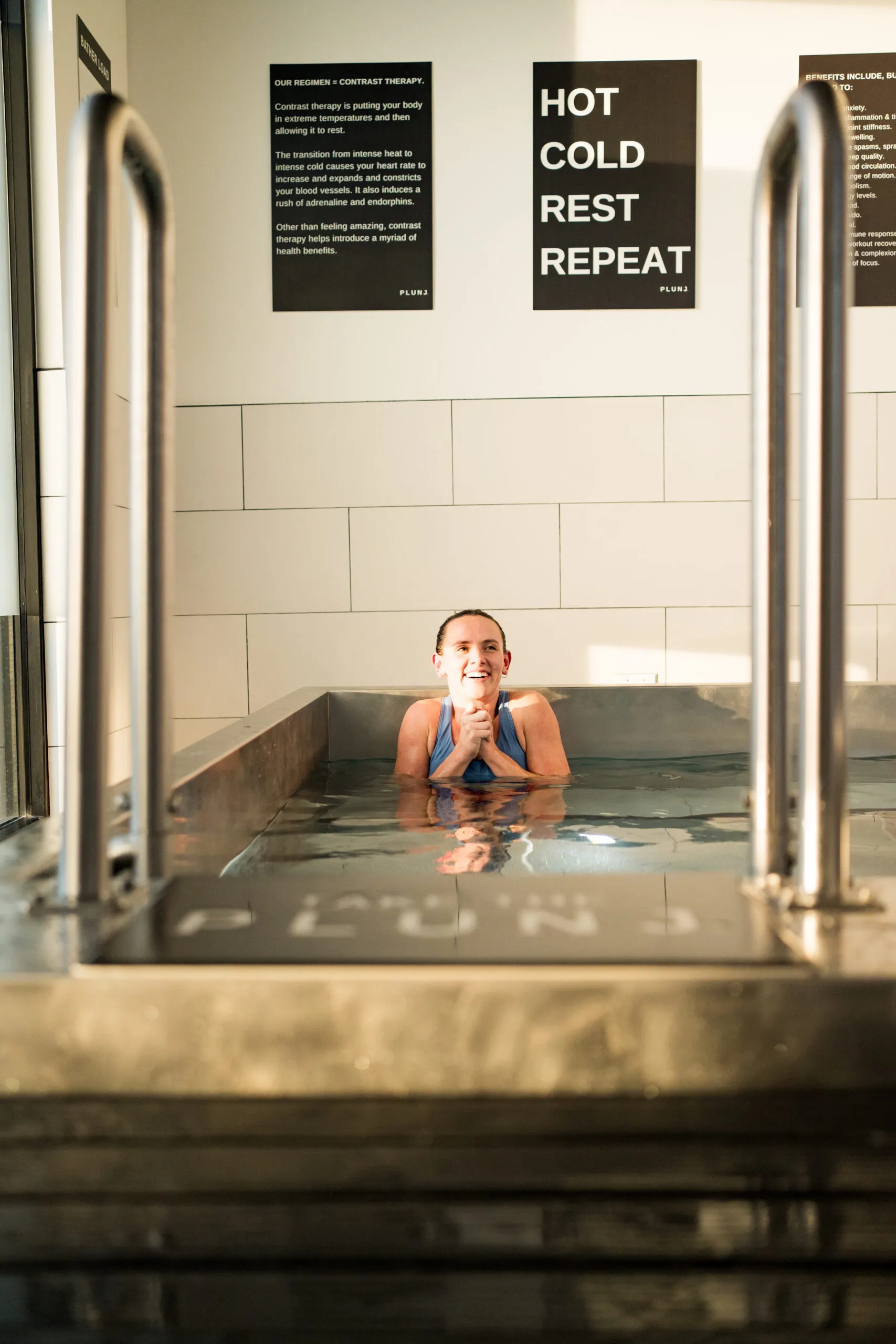
Curious what a real cold plunge session feels like? Book a session at PLUNJ and experience the hot-cold-rest-repeat regimen for yourself.
Sources:
Cannon, B., & Nedergaard, J. (2004). Brown adipose tissue: function and physiological significance. Physiological Reviews, 84(1), 277-359.
van der Lans, A. A., Hoeks, J., Brans, B., Vijgen, G. H., Visser, M. G., Vosselman, M. J., ... & van Marken Lichtenbelt, W. D. (2013). Cold acclimation recruits human brown fat and increases nonshivering thermogenesis. Journal of Clinical Investigation, 123(8), 3395-3403.
Lee, P., Linderman, J. D., Smith, S., Courville, A. B., Brychta, R. J., Dieckmann, W., ... & Yadav, V. K. (2014). Irisin and FGF21 are cold-induced endocrine activators of brown fat function in humans. Cell Metabolism, 19(2), 302-309.
Søberg, S., Løkke, A., Qvist, J., Østrup, O., Ringkøbing, S., et al. (2021). Altered brown fat metabolism but preserved morphology in the coldest humans. Cell Reports Medicine, 2(12), 100465.
van Marken Lichtenbelt, W. D., Vanhommerig, J. W., Smulders, N. M., Drossaerts, J. M., Kemerink, G. J., Bouvy, N. D., ... & Teule, G. J. (2009). Cold-activated brown adipose tissue in healthy men. New England Journal of Medicine, 360(15), 1500-1508.